
Tuesday, 24 February 2026
Sunday, 22 February 2026
GREEN AND BLUE INFRASTRUCTURE DEVELOPMENT IN URBAN AREAS

Green and Blue Infrastructure (GBI)are characterized as “Green-Blue Urban Grids” by embracing storm water management,
climate adaptation and multifunctional green space. A typical blue-green infrastructure project may have several socioeconomic and environmental benefits but its implementation in brown field city and creation of new GBI is a challenging
task for ULBs. It is very important to bring functional, social, and economic changes through GBI developments in distant
areas/districts in urban areas. In outlook of GBI, urban area may cherish as integrated system of ‘socio-ecological’ and
‘socio-blue economy’. In socio-ecological context, planning and design of urban green spaces create socio-environmental
integrity whereas socio-blue economy provides social and economic sustainability to the communities through various
micro economical activities. In fact, GBI keep cities more sustainable with ‘greater likelihood’ and ‘sufficient livelihood’.
The Green Infrastructure (GI) refers to nature-based solutions to address various environmental and social challenges whereas Blue Infrastructure (BI) refers to the network of water bodies and water management systems to provide environmental, social, and economic benefits by managing water which include both natural and engineered features. In other words, green infrastructure is considered a subset of "Sustainable and Resilient Infrastructure". It includes low-carbon infrastructure such as renewable energy infrastructure, public transport systems, etc. which contribute less emission, less carbon footprints and keep urban areas more clean and green.
Blue Infrastructure and Green Infrastructure: An Integrated Understanding:
Blue Infrastructure and Green Infrastructure termed as Blue-Green Infrastructure (BGI) includes both "blue" elements such as rivers, lakes, ponds, wetlands, green roofs, etc. which bring about water flow & storage, whereas "green" features such as parks, urban forests, green walls, roof-top gardens, etc. help with infiltration, filtration, evaporation, transpiration, etc. Sometimes, Blue-Green Infrastructure is also characterized as “Green-Blue Urban Grids” by embracing storm water management, climate adaptation and multifunctional green space.
In broader sense, Blue-Green Infrastructure may also be considered as a component of sustainable urban drainage system which is integrated into urban planning to manage storm water. Therefore, sustainable urban drainage plan is always part and parcel of Master Plan of any town and city to avoid water logging, urban flooding, etc.
Further, Blue-Green Infrastructure is also associated with Gray Infrastructure. Gray Infrastructure is nothing but conventional storm water management system such as pipes, culverts, basins, etc. which are designed to collect and convey storm water away from urban areas. Table 1 describes comparative understanding of green infrastructure, blue infrastructure and gray infrastructure as shown below.
Integrated
Understanding of Green Infrastructure, Blue Infrastructure and Gray
Infrastructure
|
Sl. No. |
Infrastructure(s) |
Understanding(s) |
Example(s) |
|
1. |
Green
Infrastructure |
Natural Process by
utilizing natural elements to manage storm water, improve water quality,
reduce urban heat effects, etc. |
Green Roofs: Roofs covered with green vegetation. Rain Gardens: Depressions in the landscape to collect and filter rainwater. Permeable Pavements: Pavements that allow water to pass through into the ground. Urban Forests: Trees and other vegetation in
urban areas. |
|
2. |
Blue Infrastructure |
It refers to all
types of water bodies (surface and underground) available in urban areas. It
is useful for water management and better micro climate at city level in
urban areas. |
Surface Water Bodies: Lakes, rivers, canals, etc. Underground Water Sources: Aquifers,
wells, springs, artesian wells, hand-pump well, etc. |
|
3. |
Gray Infrastructure |
It is traditional
approach to manage storm water and removethe same from urban areas speedily.
In other words, Gray infrastructure focuses on both traditional and
engineered solutions used for managing storm water in urban areas. |
Storm Water Management: Gutters, drains, pipes, detention basins, storm water sewer lines, etc. Wastewater Management: Sewage treatment plants, pipelines, etc. |
In fact, Gray infrastructure is crucial as it need technically design and proper maintenance otherwise may cause situations like water logging, urban flooding, etc. and damage water sources and qualities.
Green and Blue Infrastructure Development in Urban Areas: Master Plan Approach:
A Master Plan of any town /city is prepared to guide planned development through various policies and development strategies to ensure coordinated and sustainable growth. In fact, it is a comprehensive and legal document guiding the city's development for a specific period, typically 20 years. Green infrastructure and Blue infrastructure are important components and hence their developments are very crucial for livable and healthy city but several Indian cities have seen a decline in green and blue features due to rapid urbanization and haphazard development. One side, built up areas of the cities is increasing and other side green spaces, water bodies, etc. are shrinking. Many Indian cities have promoted green and blue infrastructure development through Master Plan provisions. The main aim is to enhance existing blue systems in the city through restoration and promote green development along them through planned strategies.
Govt.
Initiatives for Green and Blue Infrastructure Development
|
Sl. No. |
Initiatives |
Govt. Agency |
Description |
Prominence |
|
1. |
Atal
Mission for Rejuvenation and Urban Transformation (AMRUT) |
MoHUA,
Govt. of India. |
It
focused on providing basic amenities like water supply and sanitation, with
an emphasis on green spaces and water body rejuvenation. |
Green
and Blue Infrastructure Development |
|
2. |
AMRUT
2.0 |
MoHUA,
Govt. of India. |
AMRUT
2.0 expands its scope to include water security, sewage management, and the rejuvenation
of water bodies. |
Green
and Blue Infrastructure Development |
|
3. |
Smart
Cities Mission |
MoHUA,
Govt. of India. |
Preserving
and developing open spaces, parks, playgrounds, and recreational spaces in
order to enhance the quality of life, reduce urban heat effects in urban
areas. |
Green
Infrastructure Development |
|
4. |
Nagar
Van Yojana |
Ministry
of Environment, Forest and Climate Change, Govt. of India. |
Nagar
Van Yojana (NVY) scheme was launched in 2020, for creation of Nagar Vans in urban
areas, which promotes urban forestry by involving local communities, NGOs,
educational institutions, local bodies, etc. Nagar Van Yojana envisages
creating 1000 Nagar Van / Nagar Vatika in Cities having Municipal
Corporation/Municipal council/Municipality/Urban Local Bodies (ULBs) for
providing wholesome healthy living environment for the residents and thus
contributing to growth of clean, green, healthy and sustainable cities. |
Urban
Forests |
|
5. |
Green
Highways (Plantation, Transplantation, Beautification &Maintenance)
Policy, 2015 |
MoRTH |
Promote
greening and development eco-friendly National Highway corridors across the
country with participation of farmers, private sector and government
institutions including Forest Department. The main objective was to reduce
the impact of air pollution and dust by planting trees and shrubs along the
National Highways. They act as natural sink for air pollutants and arrest
soil erosion at the embankment slopes. |
Eco-friendly
NH Corridors |
|
6. |
"Scheme
for Special Assistance to States for Capital Investment 2023-24" -
Part-III (Urban Planning Reforms) |
DoE,
MoF |
Strengthening
Natural Ecosystem of Urban Areas through Urban Planning Aspects of the
Reform: Policy interventions for urban water management and implementation of
projects on ground for creation of Sponge Cities, including Urban Forests.
Objectives of these reforms were to restore the city's capacity to absorb,
infiltrate, store, purify, drain, and manage rainwater and regulate the water
cycle. Master Plan for Sponge City is to be complemented with a Water
Sensitive Urban Design (WSUD) document and enforcement mechanism. States is
also to develop urban forests that can be defined as networks or systems of
groups of trees, located in urban and peri-urban areas |
i.
Promotion of Sponge Cities for Sustainability (Conservation &Rejuvenation
of Water bodies) ii.Promotion of Riverfront Development iii.Creation of Urban
Forests |
According to the World Economic Forum, green and blue infrastructure is one of proactive adaptation for sustainable development, and enhanced quality of life for urban populations. The outcomes of research shows that 'green' and 'blue' infrastructure such as urban parks, wetlands, bioswales & water plazas, etc. mitigate physical risks and foster social cohesion critical to surviving and recovering from crises. In this context, it is imperative to understand that restoration & preservation of existing BGI and creation of new BGI are optimistic approach for sustainable, resilient and healthy urban environments in Indian cities. This approach integrates natural features such as parks, wetlands, urban forests and water bodies with built infrastructure which is very much desirable for addressing climate change, improving water management, and enhancing quality of life.
Green and Blue infrastructure (GBI) may be recognized as a tool for mitigating the impacts of urban heat islands, flooding, water scarcity, rapid storm water runoff, etc. Further, GBI offers improved public health and well-beings of the city residents through improved air &water quality, increased green spaces for recreation, cooling effects, etc. The need of the hour is to integrate GBI with existing infrastructure particularly with existing gray infrastructure. It requires holistic and effective approach to urban development and hence Govt. incentives and financial assistances are required through various schemes and programs for the same.
Presently, innovation and technological
advancements are required for optimizing GBI
design and implementation. The bioswales, rain
gardens, etc. as landscape elements need to be
created for capturing , filtering, and infiltrating storm
water runoff along roadsides and in open spaces,
parks, etc. Furthermore, blue-green action plan
with innovative solutions like blue and blue-green
roofs, painting of roof surfaces, walls to absorb
rainwater, reduce storm water runoff, etc. need to be
implemented by the Urban Local Bodies. Apart from
green spaces, planting more trees, creating new
urban forests, etc. it is also important to use cool
pavements through using light-colored or reflective
pavements to reduce heat absorption, moderate
surface temperatures, etc. for urban cooling effects.
It is a high time to restore and create wet lands for
detention and filter rainwater, replenish groundwater
and enhance biodiversity.
NET ZERO ENERGY GREEN BUILDINGS

Net zero energy or zero energy building is a building with net zero energy consumption during its operation & maintenance on annual basis. Thus in a net zero energy building, total amount of energy consumed by the building on an annual basis is equal to the amount of renewable energy generated in the building either onsite or offsite. When such amount of renewable energy is generated at site, the building is known as onsite net zero energy building otherwise offsite net zero energy building. When generated energy is more than consumed, it is called energy plus or positive energy building. The objective of net zero or net zero plus buildings is to contribute in saving environment and contribute less in generating greenhouse gases during its operation while objective of green buildings is to construct eco-friendly energy efficient and water efficient building having comfortable hygienic indoor air quality. Therefore, ideally a building should be net zero energy green building conforming to sustainable development, environment friendly and for wellbeing of occupants.
Features of a Net Zero and Green Building:
I. Features of Net Zero Buildings
- Building envelope and its orientation to minimize energy consumption and HVAC loads.
- Energy efficiency measures by adoption energy conservation through energy efficient fans, lights, ACs, electric pumps, and other electric equipment.
- Energy generation through renewable energy resources like solar, wind, bio mass etc.
- Regeneration of electric power through nonconventional sources like regenerative lifts, floor friction measures.
- Providing energy efficient gadgets and equipment requiring electric power.
- Bringing down the HVAC load by circulation of cool water in the cooling system for example through geothermal system.
- Providing sun reflective building materials, paints and coatings during summer and sun absorbing during winter.
- Providing energy insulation in the outer walls/ surface and roof.
- Energy efficient design of the building.
- Constructing smart homes avoiding wastage of energy.
- Reduction of carbon footprint
II. Features of Green Buildings
- Energy efficient
- Water efficient
- Comfortable and hygienic indoor air quality
- Green and sustainable building materials
- Waste minimization
- Structural efficiency
- Durability and safety
- Preservation of natural materials
- Reduction of air, water and noise pollution
- Welfare of construction employees at site and reduction of adverse health impact during its occupancy
- Innovations in adoption of eco-friendlymeasures
Cost of Net Zero Energy Building:
Green buildings are reported to be costly compared to conventional buildings by 2 to 18% and payback period is reported to be varying from 3 to 7 years. Since life of a permanent RCC framed building is considered to be 75 years, in long run it always becomes economic. Vyas and Jha (2018) have reported that average increase in initial cost of green building is 3.10% for three-star rating and 9.37% for five-star green building. A five star rated building can be considered equivalent to platinum rated building. Further, they have reported that discounted payback period for green buildings is 2.04 to 7.56 years for three-star and 2.37 to 9.14 years for five-star rated projects. Thus, discounted payback period and additional cost in case of green buildings depend upon the green rating though it is obvious.
India’s Commitment:
India has promised to cut its emissions to net zero by 2070. Hon’ble Prime Minister Narendra Modi made the pledge and first time India has set a net zero target, at the Glasgow summit. Net zero, or becoming carbon neutral, means not adding to the amount of greenhouse gases in the atmosphere. India has large network of thermal power plants as such it has to switch over to carbon neutral power generation resources. Therefore, it is likely that hydro power plants will also be in the ambit of net zero mission of carbon free emissions including renewable resources like wind, solar, tidal and bio mass power generation. Net zero carbon emissions can be achieved through onsite or offsite green power generation.
ECO HOMES: A SUSTAINABLE SOLUTION FOR MODERN LIVING

The concept of an Eco-house (or Eco-home), an environmentally low-impact home designed and built using materials and technology that reduces its carbon footprint and lowers its energy needs, is an upcoming and intriguing concept. Presently, around 40% of the carbon footprint is generated by construction and buildings industry due to various processes like lighting, cooling, and heating of building materials (outlook India), it is imperative to explore concepts like Eco-homes that supports in meeting sustainability needs such as conserving water, reducing wastes, controlling emission, generating energy, and supporting its conservation, thereby reducing building’s carbon footprint. The paper presents and discusses one of the success stories of such eco-home and elaborates its building service system.
The evident results of climate change and global warming including erratic weather changes have made people more aware about the impacts of their activities on nature and its cycles. Enhancing awareness has led to many global trends to work towards more sustainable and environmentally conscious practices. Energy efficient and sustainable homes is one among many practices that have gained much popularity in recent years. Eco homes, also known as sustainable homes, offer a practical solution that enables people to live in a manner that is both comfortable and environmentally sustainable.
The philosophy behind eco homes is that one can live a comfortable lifestyle without degrading the environment. Eco homes are built with the aim of reducing the impact that homes have on the environment. Unlike traditional homes, which are designed primarily for comfort and aesthetics, eco homes are designed to incorporate sustainable materials and techniques that reduce energy consumption. They offer an opportunity to live in surroundings that are free from toxins and waste, thereby ensuring a healthy living environment. Moreover, eco homes offer significant energy savings, which translates into lower utility costs. With the use of sustainable materials, eco homes are also able to minimize construction waste and reduce the need for maintenance. Eco homes are designed to utilize natural resources, such as sunlight and wind, in order to provide cooling, heating, and lighting. Some of the common techniques used in the construction of eco homes are:
- Passive Solar Design: Passive solar design makes use of the sun’s natural energy to provide heating and cooling. This design incorporates features such as large windows, insulated walls, and a well-ventilated roof, all of which are aimed at regulating the temperature inside the home.
- Insulation: Thorough insulation in walls, ceilings, and floors plays a critical role in the energy efficiency of eco homes. Insulation minimizes energy loss and ensures that the home stays cool in the summer and warm in the winter.
- Rainwater Harvesting: Rainwater harvesting entails the collection of rainwater for use in various domestic purposes such as toilet flushing and irrigation. By utilizing rainwater for domestic purposes, eco homes are able to conserve water and minimize the need for expensive water supply methods.
- Use of Sustainable Materials: The use of sustainable materials such as bamboo, reclaimed wood, and recycled glass is a hallmark of eco homes. These materials are eco-friendly and durable, making them an ideal choice for a sustainable home.
IMPORTANT FEATURES OF THE ECOHOUSE
The house features an open plan design, allowing
natural light to flood in and creating a feeling of
spaciousness. The interiors are decorated with a
minimalistic approach, with neutral colors and simple
furnishings that spotlight the unique architectural
design of the house. The living room features floor
to ceiling windows that offer unobstructed views
of the gardens and outdoors. The furniture used
indoors is majorly made from cane or bamboo with
cotton upholstery, and the curtains used are made
of jute, which can be used for composting once its
designated life is over. The sloping roof of the house ensures that the indoor temperature is maintained
using the stack effect - where the hot air rises and
exits through the highest point of the roof and is
replaced by the cool air in the lower habitable level.
The indoor temperature is also regulated using the
indoor ponds which offer a way to cool the interiors
by adding moisture in the air.
1. Zero power
- Solar and wind power – The roof angle is selected in such a way that solar panel can be laid directly on it without having any fabricated structure which looks artificial. The Solar Panel capacity is 7.5 KW. A hybrid system installed for producing enough electricity throughout the year. One small windmill is also installed to cater to the house’s needs during monsoon when sky is cloudy, and the Solar output is lesser. The windmill runs almost 24 hours a day during monsoons due to the wind conditions. A part of the solar power is stored in the battery and the rest of it is fed back into the grid.
- Passive solar principles- The residence is designed with passive solar principles, which ensures that the home remains cool in the summer and warm in the winter, in turn reducing the electricity requirement. The large windows oriented towards the south captures maximum sunlight, while the roof is designed to provide shading during the summer months.
2. Sustainable materials
One of the most
unique features of the villa is the use of ecofriendly materials. The house is constructed
using locally sourced materials such as stone, brick, and concrete, which are known for their
durability and sustainability. Mr. Patel has also
made use of recycled materials such as reclaimed
wood, which adds a touch of rustic charm to the
house. The walls of the house are constructed
using stone and exposed bricks and designed
using a type of wall construction known as rattrap bond. In this type of wall construction,
there is a hollow cavity that provides insulation
to the indoor environment from the outdoor
environment. Certain intricate elements such as
adding holes in the walls to accommodate bird
nests make the residence even more appealing.
Mr. Patel proudly calls them as “Living walls”.
3. Water requirement
Water requirement is
fulfilled by capturing the water from the rains
that fall on the roof, and the water is stored in
tanks that are placed above living room, which
ensures that the water comes down through
natural gravity and maintains adequate water
pressure. The excess water, after passing
through three-chambered filter using sand,
gravel and charcoal medium respectively, is
stored away in an underground tank of 2,00,000
lakh liter capacity for domestic consumption.
These three chambered filters are constructed
with RCC. The first chamber comprises of a SS
sieve over bed of gravel which will remove leaf
and other such impurities. Second chamber has
wood charcoal under a layer of sand while the
third chamber again has SS sieve again which
does not let sand flow into the tank. Then there
is a system of groundwater recharging as the
water falling on the rooftop is either collected
in the water tank or goes into the earth after
passing through the filter comprising of bricks
and gravel.
Drinking water requirement is met by using a
“five-pot” water purification system, where the
water is made to seep through five pots which
have limestone chips, coconut shell charcoal,
fine sand in the second, third and fourth pot. In
the fifth pot, which has drinkable water, a silver
coin is placed. This system naturally removes off
impurities such as sediments and e-coli bacteria
besides adding crucial minerals and ensure that
the water is fit for drinking.
Saturday, 21 February 2026
Tirupati’s Trash Turns Trendsetter
Under Swachh Bharat Mission-Urban 2.0, Tirupati Municipal Corporation has scripted an inspiring story of circular economy through its Comprehensive Upcycling Initiative, where waste doesn’t end its journey, it begins a new one. Guided by the belief of Swachh Aadat se Swachh Bharat, the initiative blends swachhata, compassion, and creativity to build a clean and green city.
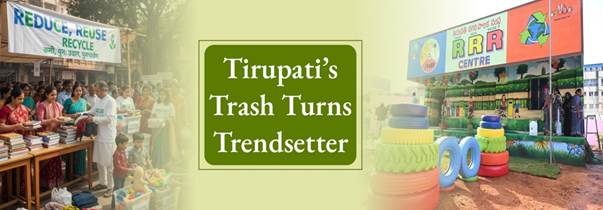
At the heart of this initiative is the concept of upcycling - transforming discarded materials into products of higher value instead of sending them to landfills. To make this vision practical and participatory, Tirupati introduced specially designed upcycling drop boxes, seamlessly linked with permanent RRR Centres.
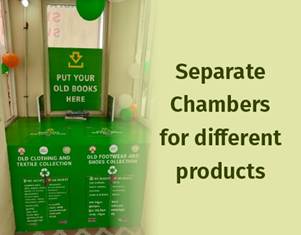
These drop boxes feature separate chambers for old books, clothes, and footwear, ensuring 100% source-level segregation. This smart design eliminates secondary sorting, preserves material quality, and makes responsible disposal easy for citizens. Strategically installed in RWAs, apartment complexes, and gated communities, the drop boxes tap into areas with high potential for reusable items, maximizing both quantity and quality of collection. A weekly, scheduled collection system with dedicated vehicles ensures smooth transportation of materials to the RRR Centres.
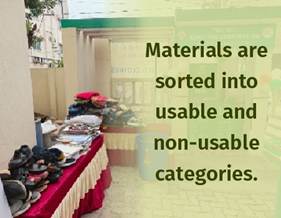
At the RRR Centres, materials are sorted into usable and non-usable categories. Items in good condition find meaningful second lives, clothes and footwear are distributed to old age homes, orphanages, the homeless, and economically weaker sections, while books help create libraries in government and municipal schools, nurturing reading habits and learning.
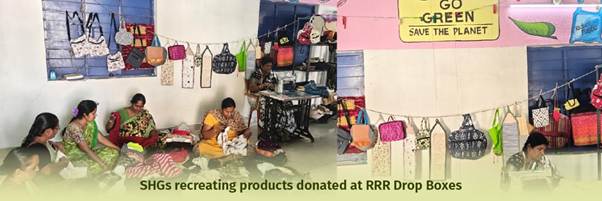
Damaged materials are not discarded either. Clothes are handed over to Self Help Group (SHG) members, who, after skill training supported by the Ministry of Textiles and the Textiles Committee, Mumbai, convert them into eco-friendly products like bags and doormats, creating sustainable livelihoods. Footwear is either locally repaired and redistributed or sent to a Bengaluru-based upcycling unit for recycling.
Used clothes are being upcycled through SHGs into value-added products, including 275 doormats, 1,025 foot mats, 2,500 cloth bags, and 0.5 tonnes of automobile cleaning cloths. These products have been successfully sold in the open market, supporting livelihoods and promoting sustainable waste management. As part of Tirupati’s circular economy journey, old books are being given a second life by strengthening libraries in municipal schools across the city, nurturing a culture of learning among young minds. At the same time, discarded footwear is channelled to authorised footwear factories for reuse, transforming waste into economic value while promoting sustainability and resource efficiency.
With enthusiastic public participation, the initiative has reduced landfill waste, strengthened social welfare, empowered SHGs, and fostered environmental responsibility among citizens. Through this thoughtful and inclusive approach, Tirupati is steadily moving towards becoming a garbage-free city, proving that when clean habits become a way of life, cities don’t just manage waste, they transform it.
Sunday, 15 February 2026
Urban Development Shield – Urban Challenge Fund
Under the new scheme announced by the Centre for the development of facilities in cities and towns, at least 50% of the cost of projects will have to be raised from the market. These funds can be raised through the issuance of municipal bonds, bank loans, and PPP mode. The remaining share will be provided by state governments and urban local bodies. According to the 2025 estimates, the scheme will be applicable to all cities with a population of 10 lakhs and above, state capitals, major industrial cities with a population of more than one lakh, and all urban local bodies in hilly/northeastern states. In total, all cities will be covered.
@ Projects will be selected in a transparent and challenge-based manner. Proposals that have a greater impact on the life of the city and have priority in reforms will be given priority.
@ Private participation will be encouraged by setting risk-sharing rules and benchmarks for civil services provided to the people.

Loan repayment guarantee for small cities:
The Centre will guarantee the repayment of loans taken by small cities in the Northeast and hilly regions and other states with a population of less than one lakh to enable them to raise financial resources from the markets. For this, a special fund of Rs. 5,000 crore is being set up. The Central Government will provide a guarantee for the first loan taken by small cities up to Rs. 7 crore, or up to 70% of the loan taken (whichever is less). If the first loan taken is repaid, a guarantee will be provided for subsequent loans up to Rs. 7 crore, or up to 50% of the loan amount. The Centre said that this will enable small cities to raise financial resources from the market to undertake projects up to Rs. 20 crore for the first time and up to Rs. 28 crore for the second time. This will be useful in increasing the lending capacity of 4,223 cities across the country, including tier-II and tier-III cities.
What should be done:
@ Repair and upgrade the legacy infrastructure in cities to meet current needs.
@ Establishment of transit corridors, urban mobility centers, economic corridors
@ Restoration/revitalization of major commercial areas/important heritage centers
@ Redevelopment of brownfield areas to meet current needs
@ Development of greenfield/semi-greenfield and major infrastructure to transform the city into a growth hub
@ Modernization of sewage and rainwater harvesting systems. Construction of water bridges.
@ Priority for solid and liquid waste management. Removal of hilly dumping yards. Integration of waste treatment can be done.
What reforms should be brought in:
Local bodies should undertake several reforms to get assistance under the Urban Challenge Fund. The main reforms to be implemented include market and financial reforms to enhance governance, digitalization, and debt repayment capacity. The efficiency of public services and consumer services should be increased. Reforms should be undertaken in urban planning, housing, and job creation. Green infrastructure should be provided.
@ Projects undertaken with these funds will have to determine 'key performance indicators' and complete them within a specific time frame. Whether they have been completed within the specified time frame according to specific standards or not will be checked by a third party.
@ The central government has stated that there is a possibility of large amounts of private investment under the scheme, thereby strengthening urban governance. It is believed that this will enable cities to be adapted to future needs in line with national development priorities.
Saturday, 14 February 2026
Right to Fair Compensation and Transparency in Land Acquisition, Rehabilitation and Resettlement Act, 2013 (RFCTLARR Act, 2013)
The Standing Committee on Rural Development and Panchayati Raj released a report on the Right to Fair Compensation and Transparency in Land Acquisition, Rehabilitation and Resettlement Act, 2013 (RFCTLARR Act, 2013).
The Report evaluated the implementation and effectiveness of the RFCTLARR Act, 2013.
RFCTLARR Act aims to provide fair compensation to those whose land is taken away, bring transparency to process of acquisition of land to setup factories, infrastructural projects & ensures rehabilitation of affected.
RFCTLARR Act replaced the Land Acquisition Act, 1894.
Key Provisions of the RFCTLARR Act, 2013:
|
Prevents arbitrary acquisitions |
Defines “public purpose” to prevent
arbitrary land acquisitions, which includes infrastructure projects,
urbanisation, and industrial corridors. |
|
Fair Compensation |
Provided for compensation up to four
times the market value in rural areas and twice the market value of land in
urban areas. |
|
Consent requirement |
80% consent of affected families for
private company projects and 70% consent in the case of PPP projects. |
|
Return of unutilized land |
If land is not used for its intended
purpose within five years, it must be returned to the original owners or
placed in a land bank. |
|
Protection of Farmers’ Land |
Special safeguards for multi-cropped and
agricultural land; acquisition only as a last resort. |
|
Protection for Scheduled Areas |
No acquisition in Scheduled Areas
violates laws protecting indigenous land rights. |
|
Social Impact Assessment (SIA) |
Before any land acquisition, the
government must undertake an SIA study. The consent process must be conducted
alongside the SIA. |
|
Rehabilitation and Resettlement |
Rehabilitation and Resettlement, which
includes entitlements for affected families e.g. house, Financial assistance
for livelihood loss, employment etc. |
|
Institutional Setup |
Provides for the establishment of
|
|
Exemption |
Notably, certain projects, such as those
related to defence, railways, and atomic energy, are exempt from the Act;
however, compensation and R&R provisions still apply. |
Key Issues in the Implementation of the Act:
- Superficial SIA/EIA: Social and Environmental Impact Assessments (EIA) are sometimes carried out as formalities with reports pre-designed to favour acquisition.
- Failure of National Monitoring Committee (NMC): The NMC has failed to quell discontent in large projects like the Ken-Betwa Link Project and Polavaram Irrigation Project.
- Faulty Implementation in Scheduled Areas: Violations occur despite statutory safeguards, including land undervaluation, superficial Gram Sabha consultations, and exclusion of vulnerable groups.
- Non-Compliance with PESA Rules: Provisions of the Panchayats (Extension to Scheduled Areas) Act, 1996 (PESA) regarding consultation are not being followed strictly in Scheduled Areas.
- Violation of the Forest Rights Act (FRA), 2006: Forest land is acquired without settling rights.
- Land Classification Manipulation: Converting Greenfield land into Brownfield and reclassifying rural land into urban areas, particularly within infrastructure projects such as Bharat Mala.
- Faulty Rehabilitation: Cash is disbursed before a demarcated and service-ready relocation site exists; land for land is offered only on paper or of inferior quality; etc.
- Structural Failures: More than a decade after the Act's enactment, many States have yet to establish the mandated LARRAs which delays justice for affected families.
Key Recommendations:
- Strengthening Role of Gram Sabha: Make Gram Sabha consent mandatory for all land acquisitions and empower it to veto proposals which are contrary to local development plans or community interests.
- Adopting a "Livelihood Value" Approach: Compensation should transition from a simple cash land value to a "livelihood value" that accounts for the loss of access to forests, water bodies, and community assets.
- Integration of LARR and FRA: Loss of customary and community forest use rights should be explicitly treated as economic displacement, requiring full rehabilitation.
- Central Monitoring of Classification: Establish a dedicated Central Monitoring and Grievance Redressal Mechanism to oversee land classification processes.
- Innovative Benefit sharing models: In addition to existing compensation and R&R entitlements, mechanism should guarantee either a share of project equity (held through a statutory trust at the Gram Sabha) or a percentage of gross project revenues, whichever is higher.
- Strengthening Rehabilitation and Resettlement for Displaced Tribal Families: No displacement until the replacement site or agricultural land is surveyed, pegged, and soil-tested, core services are functional, etc.
- Digital Transparency: All acquisition-related documents—including SIA reports, compensation details, and R&R status—should be published on an official transparency portal
- Other: Urgent establishment of LARRAs in all States and UTs. The Department of Land Resources must ensure both EIA and SIA are strictly followed to effectively mitigate adverse environmental and social impacts.
The RFCTLARR Act, 2013, is a progressive law, but poor implementation, weak monitoring, and dilution of community
safeguards have limited its effectiveness. The Committee emphasises empowering Gram Sabhas, ensuring strict
compliance with PESA and FRA, and strengthening rehabilitation and oversight mechanisms to make land acquisition
fair and people-centric.
LAND REGISTRATION SYSTEM IN INDIA
Supreme Court in Samiullah v. State of Bihar case has called for a fundamental reform in country's land registration and titling system.
> The Supreme Court of India struck down Bihar's rule making mutation proof mandatory for property registration, reaffirming that registration records transactions, not ownership.
> It reiterated that document registration under the Registration Act, 1908, only records a transaction, while mutation (updating revenue records) is a separate process that doesn't confer title.
> The Court criticized the "bureaucratic loop" created by outdated land records in India and suggesting a national push for modern, digital, conclusive titling to establish clear ownership.
Land Registration System in India:
Land is a “State subject” and registration of deeds is a concurrent list subject under the Schedule VII of the Constitution.

Issues with the existing Land Registration System in India:
- Outdated legal framework: India's property transaction system continues to operate under colonial framework governed by century-old statutes i.e. Transfer of Property Act, 1882, Indian Stamp Act, 1899, and Registration Act, 1908.
- No Conclusive Title: Registration of sale deed under Registration Act does not guarantee ownership instead it only serves as a public record of transaction having presumptive evidentiary value and not conclusive proof of title.
- Litigation burden: Fake and fraudulent property documents, land encroachments, verification delays, system of presumptive title through registration, and fragmented state-level procedures leads to 66 percent of all civil litigation.
- Administrative problems: Physical presence of buyer, seller, and two witnesses for verification, authentication and recording at sub-registrar offices makes land registration cumbersome and time-consuming. o Moreover, since land is a state subject, procedures differ across States, resulting in fragmentation and lack of uniformity.
- Incomplete Digitisation: Programmes like Digital India Land Records Modernization (DILRMP) and National Generic Document Registration System (NGDRS) digitise records but do not correct faulty and unclear titles.
Supreme Court’s Call for Systemic Reformation: Conclusive Titling and Technology:
Conclusive Title: Court has directed the Law Commission of India (LCI) for creating a committee with State participation to examine and integrate property registration regime with conclusive titling.
Restructuring old laws: LCI should prepare a report on restructuring century-old colonial-era laws governing property transactions, including Transfer of Property Act (1882), Registration Act (1908), and Stamp Act (1899), to align them with modern technology.
Synchronization: Align registration with real-time land-holding records, ensure mutation records, survey and settlement operations are timely and accurate so that the registration reflects actual holding.
Regulatory Authority: Establish a permanent regulatory body for registration offices to build institutional memory and enable real-time assessment and upgradation of the registration establishment.
- Blockchain Technology based Land Titling: It can create a secure, transparent, tamper-proof land registration system, where each record becomes part of cryptographically linked ledger that cannot be altered without detection. Thus, enhancing integrity of title records.
- Blockchain is a decentralized, immutable digital ledger that securely records transactions across a network of computers (nodes).
- It organizes data into "blocks" that are cryptographically linked in a "chain," making records transparent, tamper-proof, and verifiable without a central authority like a bank or government.
- It could integrate cadastral maps, survey data and revenue records into a single, verifiable and accessible digital framework, thereby reducing fraud, improving traceability and enhancing public trust in land ownership.
A future-ready land governance architecture anchored in conclusive titling, harmonised laws, accurate land records and emerging technologies like blockchain, can significantly reduce disputes, enhance ease of transactions and restore public trust. Such reforms are essential not only for securing property rights but also for unlocking land’s potential as a driver of economic growth, urban planning and social justice.
Subscribe to:
Comments (Atom)