Saturday, 14 February 2026

LAND REGISTRATION SYSTEM IN INDIA

                Supreme Court in Samiullah v. State of Bihar case has called for a fundamental reform in country's land registration and titling system.

>  The Supreme Court of India struck down Bihar's rule making mutation proof mandatory for property registration, reaffirming that registration records transactions, not ownership. 

> It reiterated that document registration under the Registration Act, 1908, only records a transaction, while mutation (updating revenue records) is a separate process that doesn't confer title. 

> The Court criticized the "bureaucratic loop" created by outdated land records in India and suggesting a national push for modern, digital, conclusive titling to establish clear ownership.

Land Registration System in India:

             Land is a “State subject” and registration of deeds is a concurrent list subject under the Schedule VII of the Constitution. 


Issues with the existing Land Registration System in India:

  • Outdated legal framework: India's property transaction system continues to operate under colonial framework governed by century-old statutes i.e. Transfer of Property Act, 1882, Indian Stamp Act, 1899, and Registration Act, 1908. 
  • No Conclusive Title: Registration of sale deed under Registration Act does not guarantee ownership instead it only serves as a public record of transaction having presumptive evidentiary value and not conclusive proof of title. 
  • Litigation burden: Fake and fraudulent property documents, land encroachments, verification delays, system of presumptive title through registration, and fragmented state-level procedures leads to 66 percent of all civil litigation. 
  • Administrative problems: Physical presence of buyer, seller, and two witnesses for verification, authentication and recording at sub-registrar offices makes land registration cumbersome and time-consuming. o Moreover, since land is a state subject, procedures differ across States, resulting in fragmentation and lack of uniformity. 
  • Incomplete Digitisation: Programmes like Digital India Land Records Modernization (DILRMP) and National Generic Document Registration System (NGDRS) digitise records but do not correct faulty and unclear titles.

Supreme Court’s Call for Systemic Reformation: Conclusive Titling and Technology: 

Conclusive Title: Court has directed the Law Commission of India (LCI) for creating a committee with State participation to examine and integrate property registration regime with conclusive titling. 

Restructuring old laws: LCI should prepare a report on restructuring century-old colonial-era laws governing property transactions, including Transfer of Property Act (1882), Registration Act (1908), and Stamp Act (1899), to align them with modern technology. 

Synchronization: Align registration with real-time land-holding records, ensure mutation records, survey and settlement operations are timely and accurate so that the registration reflects actual holding.

Regulatory Authority: Establish a permanent regulatory body for registration offices to build institutional memory and enable real-time assessment and upgradation of the registration establishment.

  • Blockchain Technology based Land Titling:  It can create a secure, transparent, tamper-proof land registration system, where each record becomes part of cryptographically linked ledger that cannot be altered without detection. Thus, enhancing integrity of title records.  

  • Blockchain is a decentralized, immutable digital ledger that securely records transactions across a network of computers (nodes).

  • It organizes data into "blocks" that are cryptographically linked in a "chain," making records transparent, tamper-proof, and verifiable without a central authority like a bank or government. 

  • It could integrate cadastral maps, survey data and revenue records into a single, verifiable and accessible digital framework, thereby reducing fraud, improving traceability and enhancing public trust in land ownership.

A future-ready land governance architecture anchored in conclusive titling, harmonised laws, accurate land records and emerging technologies like blockchain, can significantly reduce disputes, enhance ease of transactions and restore public trust. Such reforms are essential not only for securing property rights but also for unlocking land’s potential as a driver of economic growth, urban planning and social justice.
Monday, 2 February 2026

INDIA IS FAR MORE URBAN IN ECONOMIC AND FUNCTIONAL TERMS THAN OFFICIAL DEFINITIONS SUGGEST: ECONOMIC SURVEY 2025-26

 “India’s cities are not merely places of residence but function as critical economic infrastructure. Density and proximity generate agglomeration economies that raise productivity, deepen labour markets, and enable innovation. The economic role of cities is therefore central to India’s growth trajectory,” said the Economic Survey 2025-26 tabled in Parliament today by Union Minister for Finance and Corporate Affairs Smt. Nirmala Sitharaman.

Economic Survey 2025-26 underlined that India is already deeply urban in economic terms, with the majority of its national output generated in cities and in urban areas. The task now is to make that urbanisation work better for citizens in tangible and intangible ways.

The survey positioned cities as economic assets that require deliberate investment and strategic planning. It stated that recognisation of cities as economic infrastructure is a necessary first step toward aligning public policy, fiscal priorities, and planning frameworks with India’s development trajectory.

CITIES ARE GROWTH ENGINES

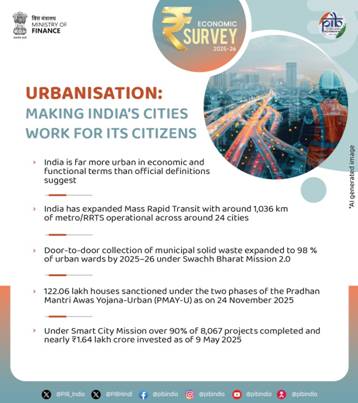
According to Economic Survey 2025-26, India is far more urban in economic and functional terms than official definitions suggest. Based on satellite data from the Global Human Settlements Layer (GHSL) of the Group on Earth Observations at the European Commission, India was 63 per cent urban in 2015, which is nearly double the urbanisation rate reported in the 2011 Census.

Economic Survey maintained that the World Bank also estimated that by 2036, India’s towns and cities will be home to 600 million people, or 40 per cent of the population, up from 31 per cent in 2011, with urban areas contributing almost 70 per cent to GDP.

MOBILITY

Economic Survey 2025-26 stated that India has materially expanded mass rapid transit system over the last decade. As of 2025, around 1,036 km of Metro/RRTS are operational across around 24 cities, with further corridors under construction.

Economic Survey also mentioned that the Government has launched PM e-Bus Sewa to strengthen city bus operations with 10,000 e-buses on a Public-Private Partnership (PPP) model, backed by ₹20,000 crore central assistance and a Payment Security Mechanism (PSM) to assure operator cashflows. During the FY 25, 7,293 e-buses have been approved across 14 States and 4 UTs, ₹983.75 crore sanctioned for depot and behind the meter power infrastructure, and ₹437.5 crore has already been disbursed

To further improve outcomes, Economic Survey 2025-26 suggested augmentation and digitisation of bus fleets, finance-first e-bus deployment, mainstreaming last-mile and shared mobility, operationalisation of Transit-oriented Development (TOD) and value capture around stations.   

URBAN CLEANLINESS

Economic Survey 2025-26 highlighted that over the past decade, the central government has undertaken one of the most ambitious and largest sanitation and waste management programmes globally under the Swachh Bharat Mission -Urban (SBM–U), complemented by investments under the Atal Mission for Rejuvenation and Urban Transformation (AMRUT) and AMRUT 2.0. These measures have yielded visible gains in sanitation outcomes, with the most notable being the elimination of open defecation across all cities.

Door-to-door collection of municipal solid waste (MSW), which was negligible in 2014–15, has expanded to 98 per cent of urban wards by 2025–26, supported by a fleet of over 2.5 lakh waste collection vehicles nationwide, according to the survey.

CITY UPGRADATION THROUGH TECHNOLOGY ADOPTION

The Survey stated that as of 9 May 2025, cities under the Smart Cities Mission (SCM)  had completed a substantial majority of planned projects — including smart roads, cycle tracks, command and control centres, upgraded water and sewerage networks, and vibrant public spaces with over 90 per cent of the roughly 8,067 projects completed and nearly ₹1.64 lakh crore invested.

The Government’s interventions to support affordable housing in urban areas including direct tax and GST benefits, inclusion in priority sector lending and provision of infrastructure status, amongst others. Under the two phases of the Pradhan Mantri Awas Yojana – Urban (PMAY-U), a total of 122.06 lakh houses have been sanctioned, of which 96.02 lakh have been completed/delivered to the beneficiaries across the country as on 24.11.2025.

Survey explained that the Pradhan Mantri Street Vendor’s Atmanirbhar Nidhi (PM SVANidhi) has played a central role in restoring and strengthening the livelihoods of urban street vendors (SV).

The Survey stated that aligning mandates, clarifying ownership of outcomes, and insulating routine enforcement from ad-hoc intervention are therefore central to making rule certainty credible in everyday urban governance.

PLANNING, GOVERNANCE AND FINANCING

The Government of India has taken a series of concerted efforts to address the financing requirements of city and urban development. The Urban Infrastructure Development Fund (UIDF), announced in the Union Budget 2023–24 with an initial outlay of ₹10,000 crore, was designed as a revolving fund routed through financial institutions to support Tier-2 and Tier-3 cities that lack creditworthiness but have viable infrastructure projects, said the Economic Survey 2025-26.

The Economic Survey tabled in Parliament today proposed that every million-plus city should be required to prepare a statutory 20-year City Spatial and Economic Plan, updated every five years, with three non-negotiable elements:

  1. a transport network plan,
  2. a housing supply plan with annual unit targets, and
  3. a land-value capture framework linked to infrastructure corridors.

SYSTEM-BASED CIVIC-SENSE AWARENESS

The survey stated that communication should reinforce predictable systems rather than substitute for them. Simple, local, and repetitive messaging focused on a small set of high-impact behaviours works best when delivered at the point of action.

CONCLUSION

Future urban policy must prioritise system performance over standalone projects—integrating housing, mobility, sanitation, climate resilience, and finance—while designing liveable, climate-ready cities that support inclusion and long-term economic efficiency.

The Economic Survey 2025- 26 said that the promise of building India’s urban future lies in making our cities economically dynamic, socially inclusive, environmentally sustainable and institutionally capable.

ECONOMIC SURVEY 2025-26 - URBANISATION: MAKING INDIA’S CITIES WORK FOR ITS CITIZENS


Saturday, 17 January 2026

Different Types of Maps - Base Map


Different Types of Maps - Cadastral Map


Different Types of Maps - Land Use Map


Different Types of Maps - Zoning Map


Different Types of Maps - Thematic Map


Different Types of Maps = Lineament Map


Different Types of Maps - Utility Map


Different Types of Maps - Environmental Map


Different Types of Maps -Physical Map


Different Types of Maps -Economic Map


Sunday, 4 January 2026

World Urbanisation Prospects 2025 — Key Facts


The UN DESA report highlights how rapidly the world is urbanising, with cities becoming the core of global population and economic activity.


Key Highlights:
✅ 45% of the world’s population (≈ 8.2 billion) now lives in cities.
✅ Number of megacities (10M+ population) rose from 8 in 1975 → 33 in 2025.
✅ Jakarta is now the most populous city, followed by Dhaka, Tokyo, and New Delhi.

 India-Specific Findings:
✅ 44% of India’s population now lives in towns and cities.
✅ India, along with six other countries, will add over 500 million new urban residents between 2025–2050 — the largest global increase.

Thursday, 1 January 2026

Year- End Review 2025: Department of Land Resources

 Department of Land Resources is implementing two Schemes/ Programmes:

  1. Digital India Land Records Modernization Programme (DILRMP) and
  2. Watershed Development Component of Pradhan Mantri Krishi Sinchayee Yojana (WDC- PMKSY)

1. Digital India Land Records Modernization Programme (DILRMP): Achieving Saturation

The Department achieved near-total saturation in the core components of land record digitization, effectively shifting land administration from "in-line" to "online".

  • Computerization of RoRs: Completed in 97.27% of villages nationwide.
  • Digitization of Maps: Cadastral maps have been digitized for 97.14% of the country.
  • Text-Map Integration: A critical milestone where 84.89% of villages have successfully linked their textual Record of Rights (RoRs) with spatial cadastral maps.
  • Impact: Citizens in 19 states can now download digitally signed, legally valid land records from home, and banks in 406 districts can verify mortgages online, significantly speeding up credit access.

2. NAKSHA: Revolutionizing Urban Land Records

Addressing the complexities of urban land management, the NAKSHA (National Geospatial Knowledge-based Land Survey of Urban Habitations) pilot programme made rapid progress in 157 Urban Local Bodies (ULBs).

  • Aerial Survey: Aerial flying was completed in 116 ULBs (87% of targets), covering ~5,915 sq. km with high-resolution imagery.
  • Ground Truthing: Initiated in 72 ULBs, with 100% completion achieved in 21 cities.
  • Incentivizing States (SASCI): Under the 'Scheme for Special Assistance to States for Capital Investment (SASCI) 2025-26', the Department successfully recommended ₹1,050 Crore in funding to 24 States/UTs that achieved specific NAKSHA milestones.

3. Strategic Launches: Land Stack and Glossary of Revenue Terms

The year concluded with two landmark initiatives launched on 31st December 2025.

  • Land Stack: Launched as a pilot in Chandigarh and Tamil Nadu, this GIS-based platform integrates land, ownership, registration, and building data. It enables departments (Revenue, Survey, Registration, Local Bodies) to operate on a unified, interoperable platform, drawing from global best practices.
  • Glossary of Revenue Terms (GoRT): To address the linguistic diversity of India's land administration, a glossary was released to harmonize terms like KhasraDag, and Pula. It provides meanings in Vernacular, Hindi, English, and Roman scripts to ensure data interoperability without replacing State-specific terminology.

4. ULPIN (Bhu-Aadhaar): A Unique Identity for Land

The Unique Land Parcel Identification Number (ULPIN), a 14-digit alphanumeric code based on geo-coordinates, has been established as the "Aadhaar for Land".

  • Coverage: As of November 2025, ULPIN has been assigned to over 36 crore land parcels across 29 States and UTs.
  • Benefits: It eliminates duplicity, prevents benami transactions, and paves the way for a unified land ecosystem.

5. NGDRS: One Nation, One Registration

The National Generic Document Registration System (NGDRS) has streamlined property transactions, promoting "Ease of Doing Business".

  • Adoption: Implemented in 17 States/UTs, including Punjab, Maharashtra, and Himachal Pradesh.
  • Integration: 88.6% of Sub-Registrar Offices (SROs) are now integrated with revenue offices, enabling automatic mutation of land records immediately after registration.

6. Policy Reforms and Social Impact

  • Gender Column in RoR: In a historic step towards women's empowerment, a mandatory Gender Column was introduced in the Record of Rights. This allows for the generation of gender-disaggregated data to support women-centric policies and targeted benefit delivery.
  • Revenue Court Case Management System (RCCMS): To tackle the backlog of land disputes, 22 States have deployed RCCMS. The system offers online filing, real-time tracking, and integration with land records to reflect court orders instantly.
  • Land Acquisition (RFCTLARR Act, 2013): The Division continued to enforce fair compensation and rehabilitation standards, ensuring that land acquisition remains humane, participative, and transparent.

7. Institutional Strengthening: Centers of Excellence (CoE)

To sustain these reforms, the Department expanded its network of Centers of Excellence (CoEs) to six, adding a new institute in Gujarat this year. These centers provide critical training on drone surveys, GIS, and modern land laws.

S.No.

Name of CoE

Jurisdiction (States/UTs)

1

YASHADA, Pune

Maharashtra, MP, Chhattisgarh, Goa

2

ATI, Mysore

Karnataka, Kerala, TN, AP, Telangana, Puducherry, A&N, Lakshadweep

3

ASSTC, Guwahati

Assam, NE States (Tripura, Manipur, etc.)

4

MGSIPA, Punjab

Punjab, Haryana, HP, J&K, Chandigarh, Ladakh

5

LBSNAA, Mussoorie

UP, Uttarakhand, Bihar, Jharkhand, WB, Odisha

6

DISRA, Gandhinagar

Gujarat, Rajasthan, Delhi, D&NH, D&D


8. Financial Discipline

For FY 2025-26, nearly 60% of the budget was utilized by mid-November, reflecting the accelerated pace of implementation.


2. Watershed Development Component of Pradhan Mantri Krishi Sinchayee Yojana (WDC- PMKSY)


  1. Watershed Development Component of Pradhan Mantri Krishi Sinchayee Yojana (WDC-PMKSY): The scheme has a Central Share of Rs. 8,134 crore for development of rainfed and degraded lands for a period from 2021-22 to 2025-26. The target area of WDC-PMKSY 2.0 (49.50 Lakh ha; corresponding to the Central Share of Rs 8,134 crore) was allocated to States/UTs and Department sanctioned 1220 projects covering an area of 52.93 lakh ha at a total cost of Rs. 12,972.86 crore (Rs. 8,487.97 crore as Central share) to 28 States and UTs (J&K and Ladakh). A cumulative amount of Rs. 5576 crore of Central fund has been released to States/UTs under WDC-PMKSY 2.0.


  1. The Department has sanctioned additional 70 watershed projects to 10 States based on the performance.


  1. The achievements have been as follows (01.04.2025 to 30.09.2025) :
  • 17,237 Water harvesting structures created / rejuvenated
  • 35,882 ha Additional area brought under protective irrigation in hectares
  • 4.86 lakh Farmers benefitted
  • 13,953 ha Plantation (afforestation/ horticulture) done


  1. Watershed YatraA mass outreach campaign titled “Watershed Yatra” was conducted during February 2025 to May, 2025, to create awareness (जनजागृति) about the Watershed Development activities carried out under WDC-PMKSY 2.0 and to generate people’s participation (जनभागीदारी) in project areas.


The Watershed Yatra was organized in 26 states and 2 Union Territories. The activities included bhoomi poojan of new woks, lokarpan of completed works, administering of bhoomi aur jal sanrakshan pledge, shramdaan, watershed ki panchayat, Watershed Janbhagidari Cup etc. The Yatra which was held in 2045 locations saw 10,432 lokarpan, 3,769 bhoomi poojanshramdan at 1902 locations, plantation of 2,18,661 saplings and an overall footfall of more than 8.5 lakh people. Learning Management System (LMS) for Watershed Development has been developed and participated by 10,557 participants.


The Yatra has helped in dramatically increasing people’s participation in the implementation of the scheme.


Watershed Janbhagidari Cup

To sustain the momentum of the Watershed Yatra, the Watershed Janbhagidari Cup was launched to foster community ownership and healthy competition among watershed projects.

Over 250 non-profit organisations have been engaged, and about 1,958 works are being undertaken through Janbhagidari at an estimated cost of ₹55.91 crore.

  1. Watershed Mahotsav:  On 11th November 2025, a nationwide campaign titled “Watershed Mahotsav” was launched by the Union Minister of Rural Development, in the presence of the Minister of State for Rural Development & Communications, to further strengthen public participation in watershed initiatives. Activities included award distribution under the Watershed Janbhagidari Cup, Lokarpan, Bhumi Pujan, Shramdaan, plantation drives, and the launch of Mission Watershed Punarutthan for repair and maintenance of earlier watershed assets. A Social Media Competition was also introduced to enhance outreach and visibility.


  1. Springshed Development activities: More than 4595 Springs have been identified by the 15 States for development under WDC-PMKSY 2.0 wherein 3357 Springs have already been rejuvenated resulting in major improvement in discharge volume and period of availability of Spring water.


  1. Under the World Bank aided REWARD program, draft National Technical Guidelines for next generation watershed projects have been finalized. It aims at integrating new age technologies like Land Resource Inventory (LRI), Hydrology and Decision Support System (DSS) based on digital soil mapping for scientific watershed planning and execution.


  1. A proposal of EFC Memo for next phase of the WDC-PMKSY 3.0 has been prepared with a total cost of Rs. 16253 cr. (Central share of Rs.10938 cr.) for taking up of conventional watershed projects plus some innovative components to be implemented outside watershed project areas such as (i) Development of 15,000 Springs (ii) Rejuvenation of rivers / streams that are on the verge of drying up or have dried up to be taken up in 8 Major States and (iii) Rejuvenation of Water bodies (including Traditional Water bodies) - to address the need of development of drought prone and rainfed areas not covered under the conventional watershed project. Extensive discussions and consultations with all the relevant stake holders i.e. State Governments, research institutes /relevant scientific organizations, ICAR Institutes, public /Pvt. sector agencies, relevant reputed NGOs have been undertaken in connection with preparation of proposed EFC memo of WDC-PMKSY 3.0.


  1. The importance of Natural Farming is strongly emphasized at the national level. Considering that the objectives of Natural Farming are closely aligned with the goals of soil health conservation, ecosystem restoration, and sustainable land management, the Department proposed to promote Natural Farming on a pilot basis in about 50,000 hectares under the proposed WDC-PMKSY 3.0, as a strategic intervention towards climate-resilient and sustainable agriculture.


  1.  A two-day National Watershed Conference was organised on 10–11 November 2025 at Guntur, Andhra Pradesh, to review the progress of WDC–PMKSY 2.0 and deliberate on the roadmap for future watershed programmes beyond 2026.


  1. National Conference on Land Resource Inventory (LRI) for Sustainable Watershed Management held during 3–5 June 2025.


  1. International Conference on “Watershed Resilience: Integrating Science, Sustainability, and Society”, organised during 26–28 November 2025 at Bengaluru under the World Bank-assisted REWARD Programme, with participation from global experts, national institutions, State Governments, and civil society organisations.

The initiatives undertaken during 2025 reinforce the Government’s commitment to sustainable watershed management, climate resilience, community participation, and long-term water security for rural India.

Wednesday, 31 December 2025

India’s Urban Local Bodies Recycle Coconut Waste into Economic and Environmental Gains

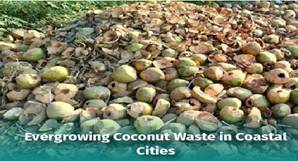
 Once a stubborn by-product of consumption, waste became an ever-growing challenge with rising populations and rapid urbanization. Answering the call of Prime Minister Narendra Modi through the Swachh Bharat Mission, India flipped the script—under the Ministry of Housing Urban Affair’s (MoHUA) leadership and SBM-U, waste is no longer a problem but a resource, transformed into products and revenue. Nowhere is this shift more evident than in coastal cities, where coconut waste—once a civic headache—has found a second life in the circular economy, turning nature’s leftovers into livelihoods and value.

No Shell Left Behind: Under SBM-U 2.0, coconut waste is powering livelihoods—coastal cities convert it into sturdy ropes and rich organic manure.

As tourists flock to coastal cities seeking clean, safe, and beautiful destinations, coconut water remains the drink of choice by the sea—healthy, refreshing, and hugely popular. That popularity once meant mountains of coconut waste heading to landfills. Not anymore. Today, coconut waste is segregated, recycled, and reborn as value—turned into cocopeat for organic manure and soil alternatives, and coir fibres spun into strong ropes. What was once a seaside problem is now a smart solution.

Coconut waste has transformed from mere “green waste” into a high-value resource. Official data shows coconut husk forms 3–5% of urban wet waste—small on paper, but massive when stacked against the 1.6 lakh tonnes of municipal waste generated daily, rising to 6–8% in coastal cities. With Karnataka, Tamil Nadu and Kerala leading production—and Karnataka now taking the top spot—India is proving that even a discarded shell can crack open big economic value.

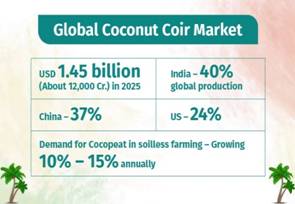
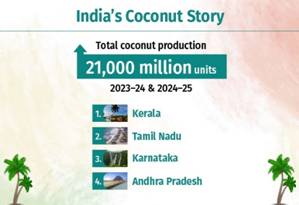
India’s coconut story is making serious noise on the global stage. As per Cocunut Development Board and Coir Board, the total production crossed 21,000 million units in 2023–24 and 2024–25, led by Kerala, Tamil Nadu, Karnataka and Andhra Pradesh contributing nearly 90%. Through this the waste-to-wealth value chain is earning both green points and foreign exchange. The global coconut coir market is pegged at USD1.45 billion (about ₹12,000 crore) in 2025, with India commanding over 40% of global production. Fuelled by booming demand for cocopeat in soilless farming—especially in Europe and the US—exports are growing at 10–15% annually, with China (37%) and the US (24%) emerging as the biggest buyers, followed by the Netherlands, South Korea and Spain.

In Karnataka, Bengaluru, Mysuru and Mangaluru, the coconut waste to wealth story is cracking open at scale.generating 150–300 metric tonnes of tender coconut waste every day. Tamil Nadu’s Chennai, Coimbatore and Madurai add significantly to the flow. From Kochi and Thiruvananthapuram in Kerala to Visakhapatnam in Andhra Pradesh, Surat in Gujarat, and Mumbai and Pune in Maharashtra, heavy coconut water consumption has led urban local bodies and private players to develop dedicated husk-management clusters. Setting the benchmark, Mysuru and Madurai have achieved 100% recycling of coconut waste, while religious centres such as Puri in Odisha, Varanasi in Uttar Pradesh and Tirupati in Andhra Pradesh have established specialised Material Recovery Facilities to process temple-generated coconut waste—ensuring that no shell is left behind.

Government schemes are giving coconut waste a serious financial push. Under SBM-U 2.0, entrepreneurs and urban local bodies are receiving robust support, with the Centre offering 25–50% Central Financial Assistance to set up waste-processing plants. The Coir Udyami Yojana sweetens the deal further, providing a 40% subsidy for micro and small enterprises on projects up to ₹10 lakh. Add to that the GOBARdhan scheme, which is rolling out 500 new waste-to-wealth plants to turn coconut residues into compost and bio-CNG—proving that when policy meets sustainability, even waste can turn profitable.

Under SBM-U 2.0, cities are turning coconut waste into opportunity with Material Recovery Facilities (MRFs) and dedicated processing units. Around 7.5 lakh people—80% women running SHG-led units—are part of India’s booming coir sector. With 15,000+ units nationwide (7,766 in Tamil Nadu alone), cities like Indore, Bengaluru, and Coimbatore are keeping 100% of coconut waste out of landfills. Nearly 90% of this waste now becomes ropes, mats, and compost instead of burning away for 10–20 years, emitting carbon and methane. Sustainable, profitable, and employment-packed—coconut waste is getting a serious glow-up.

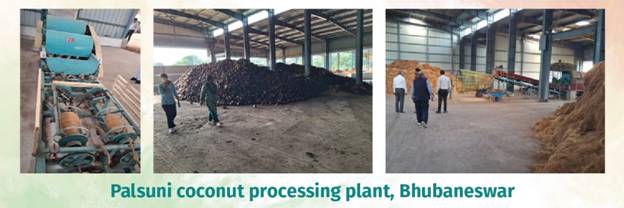
Bhubaneswar’s Palsuni coconut processing plant is turning sacred waste into wealth. It collects 5,000–6,000 coconuts daily from 189 vendors—once discarded temple remnants that clogged drains—and transforms them into 7,500+ kg of coir fiber and ropes, plus 48 metric tonnes of cocopeat-based compost and blocks for farming and gardening. With a 10,000-coconut daily capacity, the plant generates ₹7–9 lakh monthly, while SHG members and Safaimitras gain steady income and dignity through technical training and employment.

Kunnamkulam, Kerala’s Green De-Fibering Unit, with its microbe-enriched cocopeat aerobic composting system is turning coconut husks and wet waste into odor-free compost. Farmers, who once discarded husks, now earn ₹1.25 per husk and deliver them themselves. Run by a six-member team, the unit not only creates local jobs but also teaches advanced composting techniques. Coconut fibers are sold for profit, and leftover short fibers are being turned into innovative bio-pots.

In Greater Chennai, raw coconut husks are converted into compost and coir fiber. Since December 2021, nearly 1.5 lakh metric tonnes of waste have been received, with over 1.15 lakh metric tonnes already processed. Run under a 20-year PPP with WasteArt Communications, the units at Kodungaiyur and Perungudi are operating at full capacity, with a processing fee of about ₹764 per metric tonne. There are nearly 30 regular buyers—including tyre companies, nurseries and forest departments.

In Indore’s coconut waste processing model with a 550 TPD bio-CNG, not a shred of coconut waste goes wasted. Coconut waste is sent straight to a dedicated unit beside the bio-CNG plant, where 20 tonnes are processed daily through a smart dual-line system: the dry line produces cocopeat that boosts soil moisture retention by up to 500%, while the wet line extracts coir fibre for ropes, sculptures and crafts. Spanning 20,000 sq ft and run by 15 workers, the unit earns about ₹20,000 a day, with three major vendors already retailing its products.

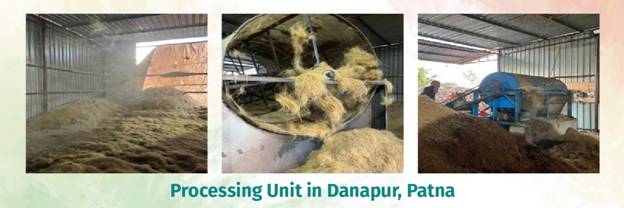
Patna, Bihar is cracking the coconut—literally—with a sharp, zero-cost waste-to-wealth model. A modern PMC processing unit in Danapur is diverting coconut waste from landfills and turning it into value, currently handling 10 TPD. Husks become coir fiber and ropes for packaging, construction, and crafts, while wet waste transforms into high-demand cocopeat and organic compost for rooftops, nurseries, and farms.

From temple towns to tech hubs, India’s coconut waste journey under Swachh Bharat Mission–Urban proves that sustainability thrives when policy, people, and innovation align.